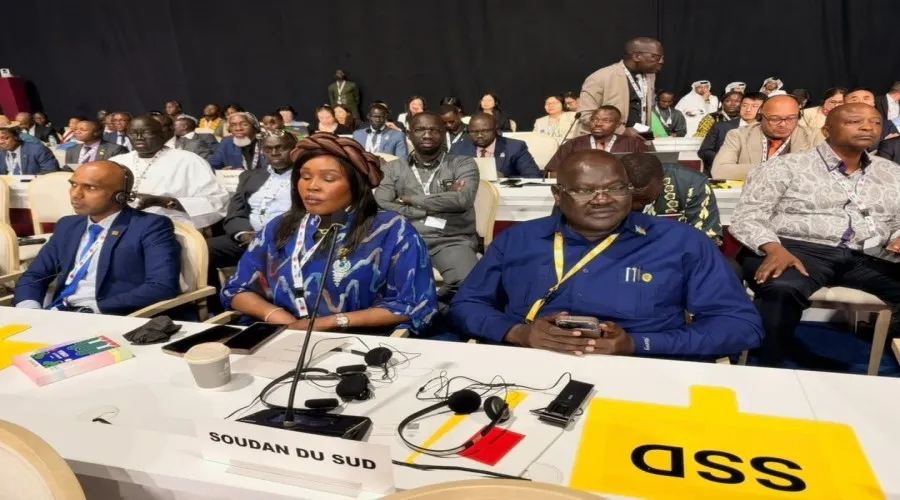
Leadership votes and diplomatic meetings
Ateny headed South Sudan's delegation in talks with other ITU Member States about telecommunications and international digital cooperation. The country's participation reaffirmed its commitment to that cooperation and to developing its communications sector at home.
His final day of high-level engagements included voting for ITU leaders. Bahrain's Adel Darwish secured the Deputy Secretary-General post with 90 votes following a third-round tie-breaker.
The elections also filled the leadership posts at the ITU's three bureaux. France's Eric Fournier received 94 votes to lead the Radiocommunication Bureau (BR), while Japan's Seizo Onoe won re-election as Director of the Telecommunication Standardization Bureau (TSB) with 169 votes. Estonia's Nele Leosk received 93 votes to become Director of the Telecommunication Development Bureau (BDT).
South Sudan offered its congratulations and wished the elected officials success in their work for the union and its members. Before leaving Doha, Ateny visited South Sudan's embassy and met with Ambassador Lily Manyiel and embassy staff.
According to ITU, leadership voting began on November 12, 2026, covering five senior posts: Secretary-General, Deputy Secretary-General and the three bureau directors. Those elections are followed by votes for the Radio Regulations Board's 12 members and the 48 Member States that will sit on the ITU Council for the 2027-2030 term.
Connectivity and technology on the conference agenda
ITU says PP-26 will help guide international investment and policy support to make technology's benefits more widely available. It places that work against a backdrop of about 2 billion people still being offline, rapid advances in artificial intelligence and expanding use of space-based technologies.
The conference also shared its venue with the GSMA-organized MWC26 Doha, held November 8-10, 2026, at the Doha Exhibition and Convention Center. ITU described holding the events alongside one another as an opportunity to bring policymakers and industry leaders together.
South Sudan's connectivity plans
At home, South Sudan's National Communications Authority has set nationwide connectivity, child online protection and regulatory reform as priorities in its 2026 digital transformation agenda. One Citizen Daily reports that the country remains among those with the lowest internet penetration in East Africa, with access concentrated heavily in cities such as Juba.
South Sudan's March 2026 national report on the Doha Programme of Action also cites the launch of a digital transformation strategy centered on nationwide connectivity, regulatory changes and online protection. The report identifies the Eastern Africa Regional Digital Integration Project (EA-RDIP) as being implemented and describes plans for a national fiber-optic network of about 2,400 km.
Work on spectrum policy and next-generation mobile services is also at the strategy-development stage. According to TechAfrica News, the NCA completed a two-day inception workshop in July 2026 to begin developing a National Spectrum Management and 5G Strategy. Participants included the Ministry of ICT and Postal Services, EA-RDIP and an expert team headed by telecommunications consultant Professor William Webb.